
The myth of natural fragrances: understanding the reality behind ISO 16128.
Since 2017 the meaning of « natural » is to be considered differently from what
one usually expects, which leads to confusion because one thinks one buys a
natural perfume that in fact isn’t natural. Here follows a detailed explanation.
Here is the Oxford definition:
Natural: Existing or derived from. Nature; not made or caused by humankind.
But since 2017 there is a new international norm called ISO 16128 that allows
cosmetic manufacturers, of which perfumes are part, to say a product is natural
from 95% naturality.
What does that mean?
Let’s start by explaining what a perfume is made of.
Look at this graphic:
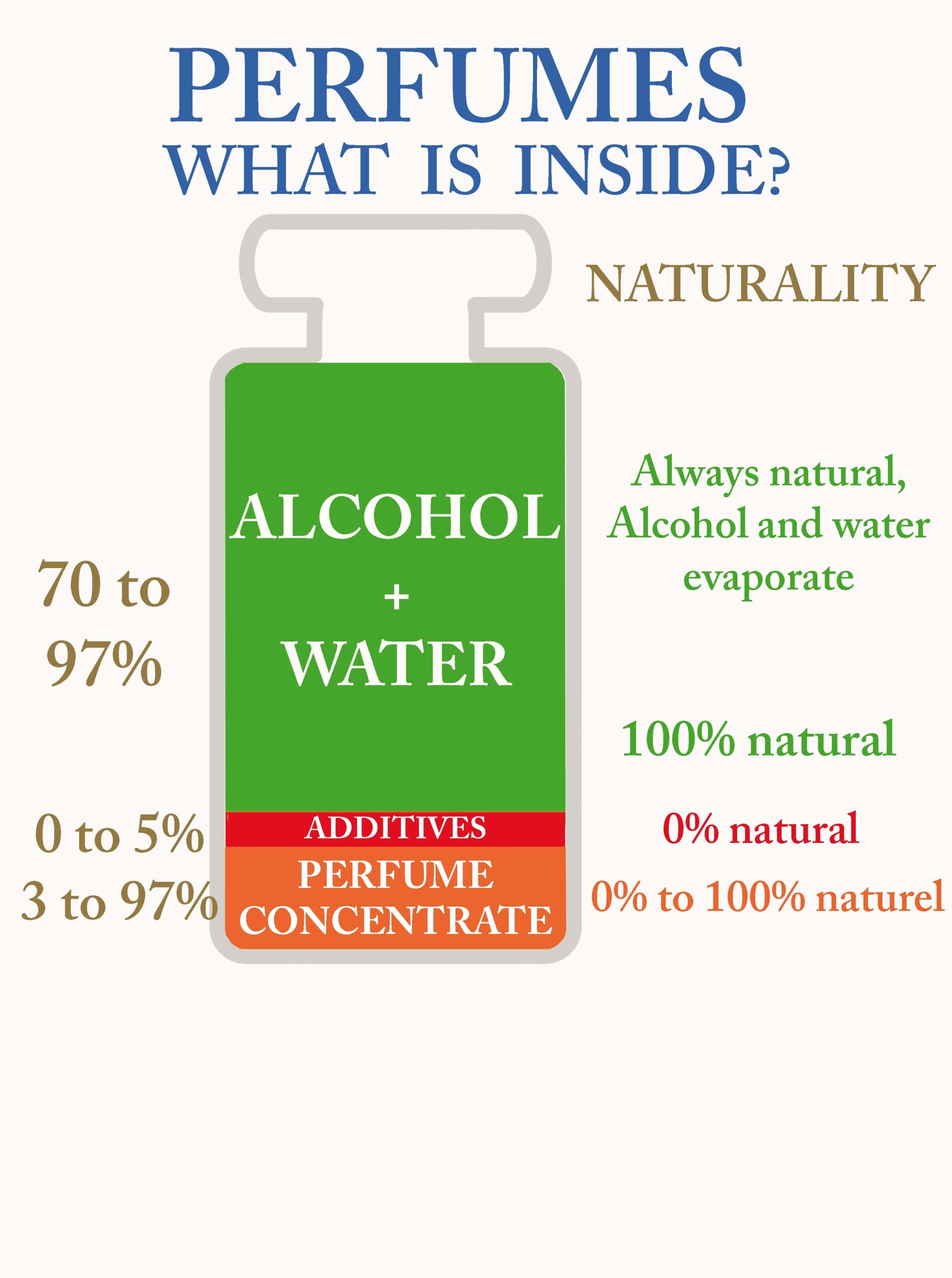
A perfume is mostly alcohol and water, then you have an aromatic concentrate (the smell) and additives.
Alcohol is always natural. It is most of the time “denaturated”, this means a very bitter molecule is added so that it’s not drinkable. (At Isotta we use what is called potable alcohol, undenaturated to avoid that bitterness-that is felt only to taste-and that molecule.
Water is always natural of course. Filtered, demineralized. At Isotta we use natural mineral water.
The aromatic concentrate It can be synthetic molecules, natural molecules, (biotech), essential oils, absolutes, or a mix.
Additives The controversial preservatives, UV filters, phthalates to dissolve certain molecules, colorants, products to prevent the discoloration, products to keep it well mixed… At Isotta, our preservative is an organic rosemary extract, and there are no other additives.
So, logically, a natural perfume should consist of:
– Alcohol (natural)
– Water (natural)
– Natural aromatic concentrate (essential oils, CO2 extracts, and natural
molecules)
– Natural preservative
Since 2017, ISO 16128 standard states that 95% natural is considered natural. In other
words, you have a perfume that is say 95% natural, and you make a concentrate that is 100% synthetic, with or without additives, you can declare your perfume as natural. Surprising, isn’t it? And this perfume will then be composed of:
– Alcohol
– Water
– Synthetic molecules
– Additives
As a reminder, alcohol and water will evaporate, leaving on the skin the perfume concentrate and additives. Everything applied to your skin enters the body. So the “natural” perfume according to ISO 16128 will leave additives and synthetic molecules on your skin. All this while making you believe it’s all natural, since officially it is. Consumers are obviously manipulated. Have you noticedthe number of “natural perfumes”?
Many small brands surf on the wave of “natural”, extolling the virtues of their “clean”, “spiritual”, “good for the planet” formulas, but in reality they are no more natural than others, or hardly so, meaning their proportion of real naturals in the concentrate may be
higher than concentional perfumes, but 92% natural is frankly not extraordinary!!!
Alcohol and water!!!
If you’re wondering how to tell if a perfume is natural (in the real meaning of the word), it’s very simple: look for “100% natural,” and I guarantee that if one does it, it will be claimed. If you can’t find it, there’s something fishy going on.
We observe that the benefits of eating organic are well understood (in theory) by the people we meet, the use of organic cosmetics (cream, shampoo..) is also appealing, but for perfume, customers remain the exception, as if perfume were invisible, probably less substantial than food or cream, engaging only to the sense of smell.
So, there you have it, you are informed, and if you are reading this article, it means you are already aware!
Thank you very much for this information. I’m so glad to have found your website!